
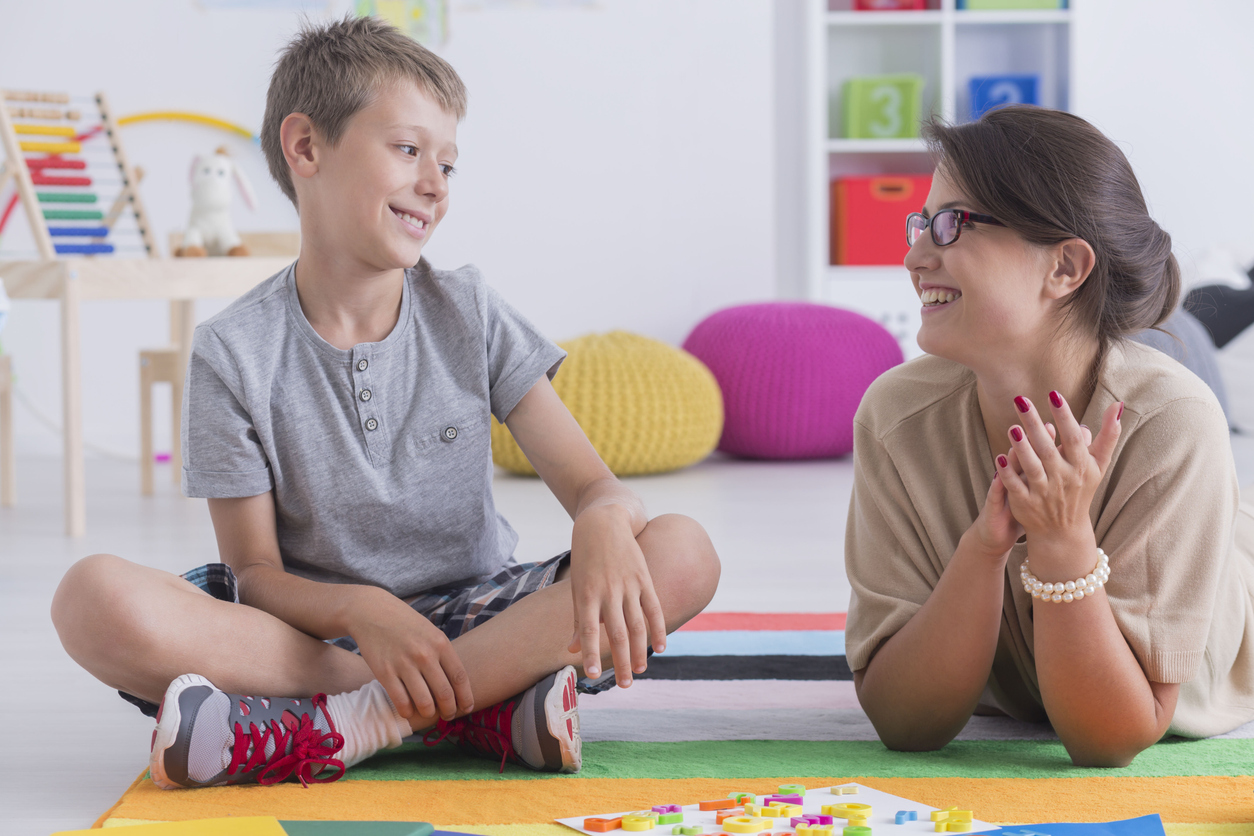
ABA and Social Skills: How Therapy Can Help Your Child Become More Social
Using various techniques and continuous support, ABA helps build social skills in children. With time and effort, your child may become more confident connecting with peers and engaging in play.
Learn more about how ABA therapy can help your child with their social skills.
Why Do Some Children Struggle With Social Skills?
If your child struggles with social skills, it’s not a matter of them being antisocial. There can be many reasons for their social challenges.
1. Speaking Challenges
A crucial aspect of socialization is being able to communicate. If your child has difficulty talking, that can hinder their social development. Things like pronouncing words properly, waiting their turn to speak, and holding a conversation with another person are all important.
Other children may not understand why your child isn’t able to speak, and may stay away from them.
2. Difficulty with Understanding Nonverbal Communication
Equally important as verbal communication is nonverbal communication. If your child isn’t able to understand body language or facial expressions, they may struggle to keep up with their peers.
3.Lack of Self-Regulation
Many autistic children struggle with self-regulation, which can affect how their peers see them. A lack of emotional or impulse regulation can affect how your child’s peers see them. Actions such as interrupting, throwing tantrums, or only doing what they want can lead to a negative impression.
4.Limited Socialization Opportunities
Sometimes children struggle with their social skills because they haven’t interacted with others. When COVID-19 first started, schools went virtual, leading to limited social opportunities for kids.
The same could happen if your child tends to interact with adults more often than children their age.
This lack of practice can lead to “simple” social mistakes that then create a bad first impression on their peers.
5.Anxiety
All of the elements above can cause social anxiety in your child. They may know that they act “differently” than other kids, but not fully understand why. They then retreat into themselves due to fear of being made fun of or left alone.
6.Lack of Confidence
In addition to anxiety, they may also lack confidence in themselves. Missing all these social cues, and potentially not understanding why, can make a child wonder, “What’s wrong with me?”
This feeling of inadequacy can get stronger if your child notices that other children seem to interact with each other easily. In children and teenagers, “fitting in” is crucial to making friends and staying out of bullies’ sights.
How Does ABA Therapy Help Children Build Social Skills?
A 2024 study by Geng Du, Yuanbing Guo, and Weihong Xu demonstrated that ABA improves social skills and communication skills in children with autism. Here are some techniques an ABA therapist and their team will use to help your child.
Related: How Long Does ABA Therapy Last?
Breaking Large Tasks/Skills Into Smaller Pieces with Chaining
Learning different social skills can be overwhelming at first, so ABA uses a technique called chaining. Chaining breaks down skills or tasks into smaller, more manageable steps.
There are two methods of chaining—forward and backward chaining. Forward chaining has the steps go in numerical order, 1–5. Backward chaining starts with the last step and works backward, 5–1.
If your child wants to play with other children and the ABA team uses forward chaining, the steps would be like this:
- Pick a child to talk to.
- Walk up to the child.
- Face the child.
- Say “Hi”.
- Ask the child if they want to play.
Together, your child and the team would work to master each step before attempting to do all the steps at once. This allows your child to focus on each step individually, avoiding feelings of frustration.
Showing What to Do through Modeling and Role Play
Some children need to be shown what to do before practicing different social skills. The ABA team would use modeling for this. Modeling is showing a certain action or how to act. The child would then try to copy what they saw.
Once they have copied the action, the two would role-play so the child can further understand why they took the action they did.
For example, the parent and ABA therapist show how to react when asked to share a toy. They either politely say no or give the toy to the other child.
They will then do the same situation with the child and gently correct their actions until the child understands.
Learning through Play
Some ABA teams use learning through play to help young children learn different tasks and how to interact with others. It’s low-stakes and fun, so a child is more likely to engage with the team.
Using this method, children can learn to express themselves, share objects, take turns, and build various motor functions.
There may be other strategies involved, such as chaining, modeling, or discrete trial training (DTT), to provide comprehensive care.
Let’s say that your child struggles to tell others what they want—leading to tantrums. With learning through play, the ABA therapist may notice your child’s focus on a toy they have and try to prompt them into communicating. This can be done verbally or nonverbally.
As they grow comfortable with communicating, the tantrums will naturally disappear.
Utilizing Structured Socialization
Structured socialization provides your child a chance to practice their social skills in real-life settings. This can be group activities with other children who also have autism or those who do not. These activities are chaperoned by the ABA team, who can step in and help your child when needed.
It’s important for your child to practice their social skills because mastering something in an isolated environment is very different from using it with others.
A 2017 study found that autistic children who participated in social skills groups had a statistically significant improvement in their social behaviors. These results were maintained at the 16- and 32-week follow-ups after the group learning ended as well.
Using Reinforcement
Reinforcement is a strategy where something is offered when a task is presented, but only given after a child completes the task correctly or uses a coping mechanism or skill. It’s important to note that reinforcement does not equate to a bribe, which is given before the action is completed.
There are four types of reinforcement:
- Positive: Offering something enjoyable for the child to look forward to after completing a desired action (the preferred reinforcement in ABA therapy).
- Negative: Taking away something unpleasant after a task is done—like having quiet time after socializing if the child doesn’t enjoy socializing, or drying hands immediately after washing if the child doesn’t like the feel of wet hands.
- Primary: Items that are needed for basic needs—food, water, etc.
- Secondary: Items that are not needed but wanted—prizes, money, etc.
For example, if your child uses a coping mechanism and prevents maladaptive behavior in an overwhelming environment, they get to eat their favorite snack that’s only for special occasions.
What Are Signs My Child May Need Help With Social Skills?
How can you know if your child is just awkward or needs extra support developing their social skills? Here are some typical signs that social skill development and support are needed.
- They don’t engage in two-way conversations.
- They struggle with eye contact.
- They can’t read body language/facial expressions.
- They don’t ask to join group activities.
- They struggle to play with other people their age.
- They act “socially inappropriately” and don’t understand why.
- They seem to have extreme social anxiety.
- They act aggressive in social situations.
How Can Parents Support Social Skills at Home?
Parents and caregivers can play a huge role in supporting their child in developing social skills. Here are some things you can do at home.
- Practice modeling at home: You can show your child positive social behaviors, such as active listening, taking turns, and asking other people questions.
- Role-play with them: Have your child practice their social skills with you in various social situations.
- Create structured social activities: Find ways to get your child in more social situations, such as playdates, clubs, or group activities.
- Use positive reinforcement: While it’s an ABA strategy, you can use positive reinforcement at home.
- Read stories together: You can use stories to help strengthen your child’s understanding of other people through stories and asking questions about characters.
- Play with them: Playing games will naturally help them develop skills like taking turns, dealing with frustration, and playing with others.
- Participate in ABA sessions: Joining ABA therapy sessions will not only show support but will also teach you how to better support your child.
Social Skills Can Be Learned with Time and Support
If your child is struggling with connecting to other kids and making friends, don’t panic. With time, ABA therapy and your support can help them develop the social skills they need to confidently go out in the world.
How long does it take ABA therapy to improve social skills?
There is no definitive timeline for how long ABA therapy takes to improve clients’ social skills. It’s best to get your child assessed and then ask the team for an estimate.
At what age can ABA therapy help with social skills?
A child can start ABA therapy as soon as two or three years old for social skills. Toddlers have different social developmental milestones compared to older children, so make sure you talk with an ABA provider.
Can ABA therapy help teenagers with social skills?
Yes, ABA therapy can help teenagers with social skills. This may require your teen to unlearn some bad social habits before progress can be seen.