

Reinforcement in ABA Therapy: What Is Reinforcement?
In ABA therapy, “reinforcement” is a word you’ll hear often, and having a clear sense of what it means can make a difference in how you support your child. Reinforcement in ABA therapy is a consistent, intentional response to a behavior to encourage more of it. It’s a core process ABA therapists use to encourage skill development and growth.
The more parents understand how it works, the more they can become a partner in their child’s progress, both in therapy and at home.
What Is Reinforcement in ABA Therapy?
Reinforcement in ABA therapy is designed to increase the likelihood that a specific behavior will happen again. Reinforcement works by adding something to, or removing something from, a situation immediately after a behavior occurs.
A few things are true of reinforcement, no matter what form it takes:
- Purpose: Reinforcement is a tool used to motivate a child to learn and grow through their ABA sessions.
- Criteria: Whether something is truly a reinforcer depends on results (if the behavior actually increases over time), not just intention.
- Goal: External reinforcers, such as rewards, become less necessary over time as a behavior becomes a natural part of the child’s routine.
ABA professionals use reinforcement intentionally, connecting it to skills tied to each learner’s individual goals, whether that’s communication, daily living skills, or social interaction.
It’s important to remember that some tasks that come easily to one child may take more effort for another. Reinforcement often provides the extra motivation children in ABA therapy need to push through challenges and experience real success, even in small steps.
These strategies are often part of a child’s larger behavior intervention plan.
Reinforcement vs. Punishment and Bribery
It’s easy to associate reinforcement with punishment or bribery, but each works differently.
|
Reinforcement |
Punishment |
Bribery |
|
|
Effect on behavior |
Increases it |
Decreases it |
Varies; often backfires |
|
Timing |
Planned, offered after the behavior |
Planned or reactive, applied after the behavior |
Reactive, often offered mid-task |
|
Mechanism |
Adding something (a privilege or reward) after a behavior |
Removing something pleasant or adding something unpleasant after a behavior |
Bargaining or offering something to get compliance, usually after some resistance |
|
Example |
“When you put your shoes on, you get to pick the song in the car.” |
“Since shoes weren’t put on right away, no movie tonight.” |
“Please put your shoes on right now—I’ll give you a cookie.” |
While all of the above technically respond to a child doing a task they might not like, the difference often comes down to when and how it’s used:
- Reinforcement is tied to completing the task and applied the same way each time.
- Punishment responds to a behavior with a consequence the child dislikes.
- Bribery offers a reward reactively, in response to resistance.
Bribery often backfires because it can reward resistance itself, which may unintentionally teach a child that pushing back is what gets a reward. Children may be less likely to cooperate the next time without a bargain.
Reinforcement, applied consistently, teaches the opposite: that completing the expected behavior is what leads to a positive outcome.
Types of Reinforcement in ABA Therapy
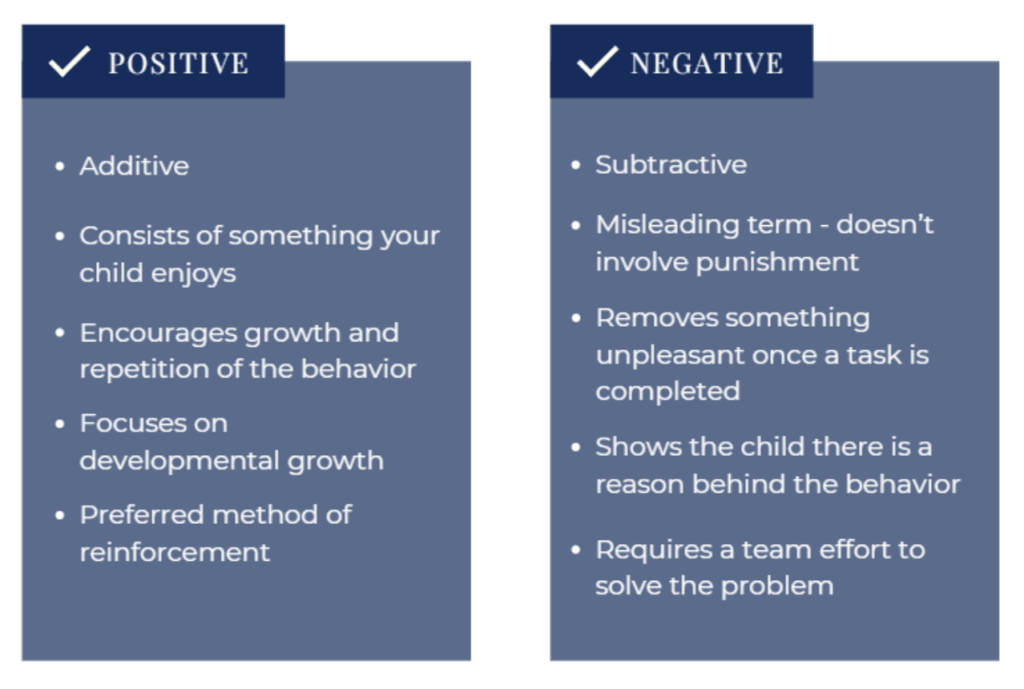
There are both positive and negative types of reinforcement in ABA therapy. Positive means something is added, and negative means something unpleasant is removed. Neither term means “good” or “bad.” When applied consistently, they both increase the likelihood that a behavior will occur again.
Positive Reinforcement in ABA Therapy
Positive reinforcement is additive. Once the desired action is performed, you add something enjoyable, such as having a play session after the child cleans their room.
It’s worth noting that something a child enjoys isn’t automatically a reinforcer. It only becomes a reinforcer when providing it helps a specific behavior take hold and continue. A toy or activity a child loves in general won’t necessarily increase behavior in every context. The effect is what matters.
The goal is for positive reinforcement to encourage continued growth and repetition of the desired behavior.

Why Positive Reinforcement Is Preferred in ABA
ABA therapy has a foundational focus on developmental growth. Punishment can be discouraging for a child (or adult) trying to learn something new, and may even cause regression instead of progress. A child afraid of making mistakes is less likely to take the risks needed for growth.
This is why we primarily use reinforcement at Spectrum Behavioral Therapies, with positive reinforcement being our preferred tool due to its positive impact on behavior and well-being.
Negative Reinforcement in ABA Therapy
Negative reinforcement is a misleading term. Most people think of it as some form of punishment, but it’s actually the opposite.
Negative reinforcement involves removing something unpleasant once a task is completed. It does not involve introducing a painful or distressing stimulus just to remove it. Negative reinforcement typically involves a discomfort that already exists naturally, and allowing a positive action to make it go away.
For example, if a child dislikes the feeling of water on their skin, drying their hands after they wash them removes the unpleasant sensation quickly. Over time, this can help the child feel less avoidant of handwashing.
Negative reinforcement is based on the idea that behavior happens for a reason, and addressing that reason can be part of the solution.
Primary and Secondary Reinforcers
Primary reinforcers are anything that meets someone’s basic needs, such as food or water. They’re referred to as primary because they meet a basic biological need and don’t need to be learned.
Secondary reinforcers, on the other hand, are conditioned. They only become reinforcing because they’ve been paired with something meaningful. Common examples are tokens, praise, and preferred activities.
Primary Reinforcers
-
- Food
-
- Water
-
- Sleep
Secondary Reinforcers
-
- Tokens
-
- Money
-
- Praise
-
- Activites
Differential Reinforcement in ABA Therapy
Differential reinforcement is an ABA strategy that reinforces a more appropriate behavior in place of one that isn’t working well for the child. Rather than focusing on stopping the original behavior directly, this method reinforces an alternative behavior that meets the same need.
For example, if a child yells to get attention, a therapist might reinforce raising a hand or using a communication tool instead.
By consistently reinforcing the alternative behavior, a child learns that it leads to the same positive outcomes, often more reliably. Over time, this approach can reduce reliance on the original behavior while building skills for lasting, independent growth.
If any of these terms are new, our glossary can help.
Examples of Reinforcement in ABA
Reinforcement can look different depending on the skill being built and the child’s individual goals. Here are a few examples across common focus areas.
Communication
- Positive: A child uses a picture card to request a snack, and the therapist provides the snack right away.
- Negative: A therapist places a toy just out of reach, and the child uses signing to ask for it. The toy is provided right away.
Daily Living Skills
- Positive: A child brushes their teeth independently and earns time with a specific toy or activity afterward.
- Negative: A caregiver gently guides a child’s hands to wash them. The moment the child begins moving their hands independently, the caregiver releases their grip.
School Readiness
- Positive: A child transitions from playtime to a schoolwork task without protest and earns a sticker toward a reward chart.
- Negative: A child remains seated during a non-preferred task, earning a break to engage in preferred activities.
Social Skills
- Positive: A child makes eye contact during a greeting and receives an enthusiastic response from a peer or adult.
- Negative: A therapist pauses in dialogue, giving the child a chance to speak up. The uncomfortable pause ends as soon as the child speaks up.
Asking for Help or a Break
- Positive: A child raises a hand to ask for help and receives assistance and encouragement.
- Negative: A child appropriately requests a break, and a difficult task is paused until they are ready to continue.
How Reinforcement Works in ABA Therapy
Reinforcement works best when given right after the behavior occurs, so the child can clearly connect the two. The size of the reinforcer should also match the effort involved.
For example, a child who completes a full day of challenging tasks might earn a large reinforcer, while a smaller reinforcer might follow a brief moment of developing social skills, like responding when someone says hello.
Continuous vs. Intermittent Reinforcement Schedules
As behaviors become more natural, reinforcers gradually shift from continuous (given every time) to intermittent (given less often), to encourage independence. Research suggests intermittent reinforcement leads to stronger behavior maintenance—meaning the behavior continues even without reinforcement.
How Reinforcement Differs by Age and Ability
Reinforcement must be tailored to the individual, since age, ability, and existing habits all affect how long a new behavior takes to develop and what motivates someone to repeat it. Starting at an earlier age can make this process smoother, though teens and adults absolutely still benefit from an individualized approach.
The same idea extends to skill levels. Each child has different strengths across different tasks. Reinforcement strategies are customized accordingly rather than applied the same way for everyone.
When a Reinforcer Stops Working
Preferences and motivation naturally shift over time, especially as a child grows or is exposed to new experiences. A reinforcer that works well one week may stop working the next.
When this happens, a Board Certified Behavior Analyst (BCBA) may:
- Reassess what the client currently finds motivating.
- Introduce more variety into the options offered.
- Adjust how often reinforcement is given.
In some cases, what looked like a reinforcer may not have actually been increasing the behavior at all, which is a sign to try a different approach entirely.
How Reinforcement Becomes More Natural Over Time
The type of reinforcer itself often shifts over time, too. A tangible item, like a small toy or snack, may gradually give way to praise.
Eventually, reinforcement comes from the natural rewards of the skill itself, like the independence of getting dressed without help or the satisfaction of successfully communicating a need.
Over time, the goal is for these naturally occurring outcomes to sustain the behavior, without needing an outside reinforcer at all.
How Do Board Certified Behavior Analysts (BCBAs) Choose Reinforcers?
Choosing an effective reinforcer starts with understanding what a specific child actually finds motivating, since this varies widely from one learner to the next.
BCBAs typically use a combination of methods during an ABA assessment:
- Formal preference assessments
- Direct observation of what a child gravitates toward
- Input from caregivers who know the child well
- Allowing the learner to choose between options
Because interests can change, this process is revisited regularly to make sure reinforcement stays effective.
This is exactly why caregiver and learner input matter so much in the process.
How to Support Reinforcement Strategies at Home
We always encourage parents and caregivers to participate in ABA therapy. In coordination with your child’s therapist, you can offer reinforcers at home for specific skills your child is working on, gradually shifting from a continuous to an intermittent schedule as the therapist recommends. This can help your child build independence rather than relying on a reward every time.
If your child is school-age, this consistency matters at school. Communication with teachers is an important part of the process. If you need assistance collaborating with your child’s school, we can help.
See the Power of Reinforcement in ABA in Action
Spectrum Behavioral Therapies can help your child grow and develop into an independent adult. Using reinforcement, collaboration, and constant communication, we’ll create a supportive environment for your child to learn and grow. Reach out to learn more about the ABA therapy journey with Spectrum Behavioral Therapies.